
 Our Editorial Team
CFA
CFP®
Our Editorial Team
CFA
CFP®
401(k) & Precious Metals Retirement Specialist • 18+ Years Experience
Sources: IRS Pub. 590-A, 590-B, IRC §402(c), §408(m) • Published: January 12, 2026 • Last Fact-Checked: April 18, 2026
401(k) gold IRA preserves pre-tax dollars under IRS Publication 590-B while shifting exposure from paper assets to physical bullion at 0.995 fineness standard for IRA gold. Birch Gold Group offers four-metal diversification including platinum and palladium, with depository custody at IDS of Delaware in New Castle.
A 401(k) gold IRA rollover moves pre-tax 401(k) funds into a self-directed IRA holding IRS-approved physical bullion — tax-free and penalty-free via direct transfer. Compare top-rated custodians below.
Our Editorial Team
CFA
CFP®






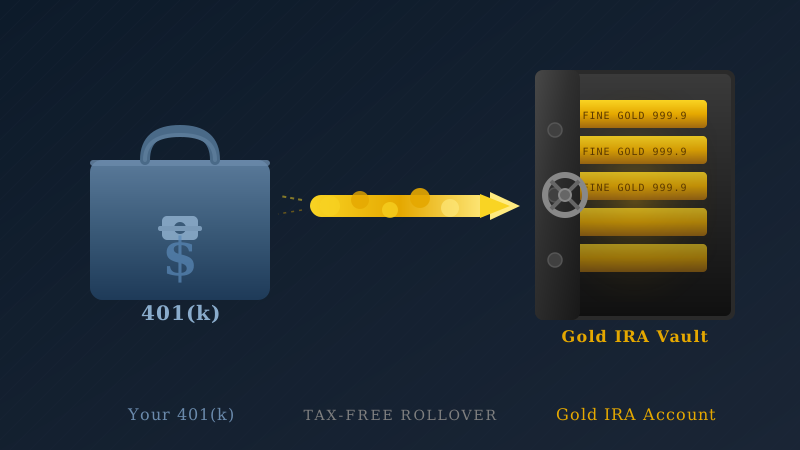 401k to Gold IRA rollover process diagram
A 401(k) gold IRA rollover moves pre-tax 401(k) funds into a self-directed IRA that holds IRS-approved physical gold and precious metals. IRC §402(c) authorizes the rollover, eliminating taxable income and the 10% early-withdrawal penalty when executed as a direct trustee-to-trustee transfer.
The key distinction: your existing 401(k) holds paper assets (stocks, mutual funds, bonds). A gold IRA holds physical metal — bars, coins, or bullion — stored at an IRS-approved depository such as the Delaware Depository or Brinks Global Services. You never physically possess the metal.
Who is this strategy designed for?
The 2026 IRA contribution limit is $7,000/year ($8,000 if age 50+) per IRS Publication 590-A — but a rollover from a 401(k) is not counted against this limit. You can roll your entire 401(k) balance regardless of size without triggering contribution cap restrictions.
The direct answer: rolling part of your 401(k) into gold is appropriate for some investors — but not all. The decision depends on your age, risk tolerance, existing portfolio allocation, and retirement timeline.
Financial planners generally recommend allocating 5–15% of a retirement portfolio to precious metals as a hedge against inflation and equity correlation. Putting your entire 401(k) into gold is not recommended by most fiduciary advisors.
Per IRC §402(c), a direct rollover from a 401(k) to an IRA is not a taxable event. The rollover does not trigger the 10% early withdrawal penalty regardless of age. However, the receiving account must be a qualifying IRA custodian — not a personal bank account or home storage arrangement.
Bottom line: A 401(k) to gold IRA rollover is a legal, tax-advantaged strategy that makes most sense as a diversification tool, not a total portfolio replacement. Consult a fee-only fiduciary advisor to determine the right allocation for your specific situation.
See why Augusta Precious Metals is a top choice for gold IRA investors.
Claim Your Free Gold Kit →Precious metals reduce portfolio volatility by 15–25% during equity bear markets because gold holds a −0.1 to +0.1 correlation coefficient with the S&P 500 (World Gold Council, 2024). A 5–10% allocation historically preserves returns while cutting maximum drawdown. Gold acts as the BLUF: when equities fall, gold typically holds or rises — providing genuine non-correlated diversification inside a tax-advantaged IRA.
Gold’s purchasing power has remained remarkably stable over centuries. In 1971, when Nixon ended the dollar’s gold convertibility, gold was $35/oz. The dollar has lost approximately 87% of its purchasing power since then — but gold has increased from $35 to $3,300+, preserving and expanding real wealth.
Since the Federal Reserve’s founding in 1913, the dollar has lost over 96% of its purchasing power. Physical gold inside a Traditional IRA grows tax-deferred, hedges inflation, and compounds until RMDs begin at age 73 — combining hard-asset protection with the tax-advantaged structure of a qualified retirement account.
The World Gold Council’s research suggests that a 5–10% gold allocation in a diversified portfolio reduces volatility without materially reducing long-term returns. The key benefit is non-correlation: gold does not move in sync with the stock market, reducing maximum drawdown during equity bear markets.
If you had invested $10,000 in physical gold in April 2006, that investment would be worth approximately $55,200 today — a total return of roughly 452% and an annualized return of approximately 8.9% per year.
For comparison, the S&P 500 total return index (with dividends reinvested) returned approximately 10.4% annualized over the same period — modestly higher than gold, but with significantly more volatility. Gold had extended flat periods: it consolidated between $1,200–$1,400/oz from roughly 2013 to 2019 before breaking out.
This calculation uses nominal (not inflation-adjusted) returns. In real terms, gold’s purchasing-power gain is lower — cumulative U.S. inflation from 2006 to 2026 was approximately 65%, meaning real gold returns were roughly 237% over this period. Still a meaningful gain, but investors should be aware of the distinction between nominal and real returns.
Past performance does not guarantee future results. Gold can experience prolonged bear markets: from its 2011 peak of $1,920/oz, gold fell to a low of $1,050/oz in December 2015 — a 45% drawdown that took until 2020 to fully recover. Investors with a short time horizon face meaningful sequence-of-returns risk.
The takeaway for 401(k) rollovers: A long-term allocation to gold inside a tax-advantaged account has historically provided meaningful returns with lower equity correlation — the combination most valuable to pre-retirees seeking to preserve wealth while maintaining tax-advantaged compounding.
See why Goldco is a top choice for gold IRA investors.
Claim Your Free Gold Kit →A 401(k) to gold IRA rollover involves five steps: choosing a custodian, opening a self-directed IRA, initiating the rollover, purchasing IRS-approved metals, and confirming storage at an approved depository.
Not all IRA custodians accept physical precious metals. You need a self-directed IRA (SDIRA) custodian — a regulated financial institution approved by the IRS to hold alternative assets. Major custodians specializing in gold IRAs include Equity Trust Company, GoldStar Trust, and Kingdom Trust.
Verify the custodian is listed on the IRS’s approved non-bank trustee list. Request a written fee schedule covering setup, annual admin, and storage costs before signing anything.
Complete the custodian’s application — typically online — and designate whether you want a Traditional gold IRA (pre-tax) or Roth gold IRA (post-tax). Most 401(k) rollovers go into a Traditional IRA to maintain the pre-tax status of the original funds.
Contact your 401(k) plan administrator and request a direct rollover (also called a trustee-to-trustee transfer). Provide them with your new gold IRA custodian’s account information. The 401(k) sends funds directly to the IRA custodian — no check is made payable to you personally.
Once funds arrive at your custodian, work with your gold IRA company to select IRS-eligible metals. All gold must meet the minimum purity threshold of 99.5% (0.995 fineness) per IRS Publication 590-B, with one exception: American Gold Eagles (91.67% pure / 22 karat) are explicitly permitted by statute under IRC §408(m)(3).
IRS-approved gold options include:
Your dealer ships the purchased metals directly to an IRS-approved depository — never to your home address. Approved facilities include the Delaware Depository (Wilmington, DE), Brinks Global Services, and IDS of Delaware. The custodian handles all IRS reporting: Form 5498 for contributions/value and Form 1099-R for distributions.
BLUF: A 401(k) holds paper assets (mutual funds, ETFs) inside an employer plan; a gold IRA is self-directed and holds IRS-approved physical bullion at an approved depository. Contribution limits, tax treatment, custodian structure, and RMD logistics differ significantly.
| Feature | 401(k) | Gold IRA (Self-Directed) |
|---|---|---|
| Asset Types | Mutual funds, ETFs, bonds, company stock | Physical bullion, IRS-approved coins & bars |
| 2026 Contribution Limit | $23,500 ($31,000 age 50+; $34,750 ages 60–63) | $7,000 ($8,000 age 50+) |
| Custodian | Employer plan administrator (Fidelity, Vanguard) | IRS-approved self-directed IRA trustee |
| Storage | Electronic — held in brokerage/plan record | Physical — IRS-approved depository (Delaware, Brinks) |
| RMD Age | 73 (SECURE 2.0) | 73 (Traditional); Roth Gold IRA has no RMDs |
| Early Withdrawal | 10% penalty + ordinary income tax before 59½ | 10% penalty + ordinary income tax before 59½ |
| Annual Fees | Near $0 (index funds) to 1%+ (actively managed) | $175–$275/yr (custodian + storage) |
Most standard 401(k) plans do not offer physical gold as an investment option. Employer plan menus are typically limited to mutual funds, index funds, and company stock. Some 401(k) plans may include a gold mining ETF (like GLD or IAU) as an option — but this provides price exposure to gold, not physical metal ownership. To own actual gold bullion in a retirement account, you must use a self-directed IRA (SDIRA), which requires rolling your 401(k) to a specialized custodian.
Disclosure: This article is for educational purposes only and does not constitute financial, tax, or legal advice. Consult a fee-only fiduciary advisor before executing any rollover. The author may be compensated via affiliate commissions from featured companies; rankings are based on BBB rating, fee transparency, and customer complaint volume.
See why American Hartford Gold is a top choice for gold IRA investors.
Claim Your Free Gold Kit →BLUF: The four main downsides of a gold IRA are (1) higher annual fees ($175–$275/yr vs. ~$0 for a standard index-fund IRA), (2) no dividend or interest income, (3) lower historical returns than equities over 30+ year periods, and (4) reduced liquidity — selling physical metal takes 3–7 business days versus same-day brokerage trades.
A gold IRA charges a custodian fee ($75–$125/yr) plus a depository storage fee ($100–$150/yr for commingled; $150–$300/yr for segregated storage), for a total of $175–$275/yr. On a $30,000 account, that represents a 0.6–0.9% annual expense ratio — compared to 0.03% for a Vanguard index fund IRA or 0.25% for the IAU gold ETF. Dealer spreads (1–5% above spot on purchase, below spot on sale) add further transaction drag.
Gold bullion generates zero income. A stock portfolio pays dividends; bonds pay interest. A gold IRA’s entire return depends on spot-price appreciation. Over long periods (30+ years), equities have historically outperformed gold in nominal terms (S&P 500: ~10.4% CAGR vs. gold: ~8.9% CAGR over 2006–2026). The tradeoff is lower correlation and inflation protection, not superior returns.
Selling IRA-held gold requires: instructing your custodian to sell the metal, the depository executing the sale, and funds clearing to your account — a process typically taking 3–7 business days. This compares to T+1 or same-day settlement for publicly traded securities. For retirees managing RMDs or unexpected cash needs, this lag requires advance planning.
Physical gold cannot be divided into fractional ounces for RMD purposes. When your Required Minimum Distribution is due at age 73, you must either sell a sufficient portion of your gold holdings (triggering a taxable distribution of the proceeds) or take an in-kind distribution of whole coins or bars and recognize the fair market value as ordinary income. Neither option is as frictionless as selling index fund shares inside a standard IRA.
Gold experienced a 45% price decline from its 2011 peak (~$1,920/oz) to its 2015 trough (~$1,050/oz) — a drawdown that took until 2020 to fully recover. Investors who entered near the 2011 peak faced 9 years of underwater performance. Physical gold also incurs storage fees during bear markets with no offsetting yield. A long investment horizon (10+ years) and position-sizing discipline (5–15% of portfolio) mitigate but do not eliminate this risk.
BLUF: The only guaranteed way to transfer a 401(k) to a gold IRA without penalty is a direct (trustee-to-trustee) rollover under IRC §402(c). An indirect rollover triggers mandatory 20% withholding and requires full redeposit within 60 days — missing the deadline results in the full amount being taxed as ordinary income plus a 10% penalty if you are under age 59½.
In a direct rollover, your 401(k) plan administrator transfers funds electronically straight to your new self-directed IRA custodian. Key facts:
In an indirect rollover, the 401(k) plan cuts a check payable to you. The IRS requires your plan to withhold 20% for federal taxes automatically. You then have exactly 60 calendar days to deposit the full original amount (including the 20% that was withheld) into your new IRA:
Per Bobrow v. Commissioner (Tax Court, 2014), the IRS allows only one indirect (60-day) rollover per 12-month period across all your IRAs combined — not per account. This limit does not apply to direct rollovers or trustee-to-trustee transfers. Violating this rule converts the excess rollover into a taxable distribution with a 10% penalty.
Rolling your 401(k) to a gold IRA while still employed with the sponsoring employer requires an in-service distribution — a feature most plans do not offer before age 59½. Check your Summary Plan Description (SPD) or contact your HR department. If your plan permits in-service distributions, the same direct-rollover rules apply: request custodian-to-custodian transfer to avoid withholding.
IRS regulations under IRC §408(m) require that gold held in an IRA be stored at an approved depository — never at your home or in a safe deposit box you control. Major IRS-approved depositories include:
Segregated vs. Commingled Storage: Segregated storage ($150–$300/yr) keeps your specific coins and bars in a dedicated vault space identified as yours. Commingled storage ($100–$150/yr) pools your holdings with other investors’ holdings of equivalent type and purity — you own a fungible quantity, not specific bars. Both satisfy IRS requirements. Segregated storage provides stronger peace of mind and is preferred for larger accounts; commingled is cost-effective for smaller positions.
See why Augusta Precious Metals is a top choice for gold IRA investors.
Claim Your Free Gold Kit →For 2026, the IRS sets distinct contribution limits for 401(k) plans and IRAs. Understanding these limits is critical to maximizing your retirement savings and planning rollovers correctly.
| Account Type | 2026 Limit (Under 50) | 2026 Limit (Age 50+) |
|---|---|---|
| 401(k), 403(b), 457(b) | $23,500 | $31,000 (includes $7,500 catch-up) |
| Traditional IRA / Gold IRA | $7,000 | $8,000 (includes $1,000 catch-up) |
| Roth IRA (income limits apply) | $7,000 | $8,000 (includes $1,000 catch-up) |
| SEP IRA | Lesser of 25% of compensation or $70,000 | Same — no catch-up for SEP |
Critical point: A 401(k) rollover to a gold IRA is not counted as a contribution. Per IRS Publication 590-A, rollovers and transfers are entirely separate from the annual contribution limit. You can roll $200,000 from a 401(k) into a gold IRA and still contribute $7,000 in new money to a separate IRA in the same year.
The SECURE 2.0 Act introduced a super catch-up provision for workers aged 60–63: starting in 2025, these individuals can contribute up to $11,250 extra to their 401(k) above the standard limit, for a total of $34,750 in 2026. This age bracket gets the highest 401(k) contribution ceiling available.
If you are covered by a workplace 401(k), your Traditional IRA deductibility phases out at:
High earners above these thresholds may use a non-deductible Traditional IRA contribution (still allowed) or a backdoor Roth IRA strategy. Consult a tax professional before executing either approach.
Bottom line: Fidelity does not offer a physical gold IRA. Fidelity is one of the largest 401(k) plan administrators and IRA custodians in the United States — but it does not custody physical gold, silver, or other precious metals inside an IRA. If you want to hold physical gold in an IRA, you need to roll your Fidelity account to a specialized self-directed IRA custodian.
Fidelity does offer gold-related investment options, but none involve physical metal ownership:
These paper-gold alternatives have lower costs (IAU charges 0.25%/year vs. $175–$275/year for a physical gold IRA) and higher liquidity. However, they do not provide direct ownership of physical bullion, and counterparty risk exists — you own a share of a trust, not the gold itself.
If your 401(k) is at Fidelity and you want physical gold exposure, the process is:
The distinction matters: a Fidelity IRA holding gold ETFs and a self-directed IRA holding physical gold coins are fundamentally different structures with different fees, liquidity, IRS rules, and risk profiles. Physical gold in an IRA provides direct ownership of an unencumbered hard asset. Gold ETFs in a Fidelity IRA provide price exposure without ownership of physical metal.
See why Goldco is a top choice for gold IRA investors.
Claim Your Free Gold Kit →The IRS sets strict minimum purity standards for metals held inside any IRA, including a gold IRA funded by a 401(k) rollover. Per IRC §408(m)(3)(B), gold held in an IRA must have a minimum fineness of 99.5% (0.995) — with one critical exception.
| Metal / Coin | Purity | IRA Eligible? |
|---|---|---|
| Gold bars (LBMA-approved refiners) | 99.5%+ (0.995) | Yes — meets IRS minimum |
| American Gold Buffalo | 99.99% (24 karat) | Yes — exceeds IRS minimum |
| Canadian Gold Maple Leaf | 99.99% | Yes — exceeds IRS minimum |
| Austrian Gold Philharmonic | 99.99% | Yes — exceeds IRS minimum |
| American Gold Eagle | 91.67% (22 karat) | Yes — statutory exception only |
| South African Krugerrand | 91.67% (22 karat) | No — no statutory exception |
| Numismatic / collectible coins | Varies | No — prohibited under IRC §408(m) |
The American Gold Eagle is struck in 22-karat gold (91.67% pure) — well below the 99.5% IRS threshold. However, Congress explicitly included it in the list of IRS-approved IRA assets via statute. The coin contains exactly 1 troy oz of gold per 1 oz denomination; the remaining alloy (copper and silver) is added for durability, not as a cost-cutting measure.
No other coin below 99.5% purity enjoys this exemption. The South African Krugerrand, also 22 karat, is not IRA-eligible because it lacks the same congressional carve-out.
Purchasing a non-approved metal (such as a Krugerrand or a numismatic coin) inside an IRA constitutes a prohibited transaction under IRC §4975. The consequence: the entire IRA is treated as distributed, the full balance becomes taxable ordinary income, and a 10% early withdrawal penalty applies if you are under age 59½. Always verify eligibility with your custodian before any purchase.
Most gold IRA rollover mistakes fall into four categories: choosing the wrong rollover method, selecting ineligible metals, misunderstanding storage rules, and ignoring fee structures. Here is how to avoid each one.
An indirect rollover means your 401(k) plan issues a check made payable to you. The IRS requires the plan to withhold 20% for taxes from any indirect rollover. You then have 60 days to deposit the full original amount (including the 20% that was withheld) into your new gold IRA.
Solution: Always request a direct rollover — custodian to custodian. No withholding, no deadline, no penalty risk.
Some dealers push numismatic (collectible) coins — coins valued primarily for rarity or historical significance rather than metal content. These are prohibited under IRC §408(m) and carry premiums of 20–100%+ over spot price. Similarly, proof coins (specially minted collector versions with mirror-like finish) are generally not IRA-eligible unless they are also IRS-approved bullion coins (e.g., Proof American Gold Eagles). Other ineligible metals include gold jewelry, gold certificates, the South African Krugerrand (no statutory exemption), and any coin falling below the 99.5% purity threshold without a specific congressional carve-out.
Always verify metal eligibility with your custodian in writing before purchase. Ask specifically: “Is this specific coin/bar on the IRS-approved list for IRAs?”
Some companies advertise “Home Storage Gold IRAs” or “Checkbook Control IRAs.” The IRS has consistently challenged these structures — in McNulty v. Commissioner (2021), the Tax Court ruled that taking personal possession of IRA-held gold constitutes a taxable distribution, disqualifying the IRA under IRC §4975. A disqualified person — defined under IRC §4975(e)(2) as the IRA owner, their family members, or entities they control — cannot take possession of IRA assets under any arrangement, including a home safe or personal bank vault. Taking personal possession of IRA-held gold — even briefly — is a prohibited transaction that disqualifies the entire IRA. Do not store IRA gold at home under any arrangement without a written opinion from a qualified tax attorney.
A gold IRA costs more than a standard brokerage IRA. Before opening any account, get a complete written fee schedule covering:
On a $30,000 gold IRA account, annual fixed costs of $225/year represent a 0.75% annual expense ratio before dealer spreads. This is higher than gold ETFs (IAU: 0.25%) but provides direct physical ownership and IRS tax advantages.
Traditional gold IRAs are subject to Required Minimum Distributions starting at age 73 under the SECURE 2.0 Act. Physical gold cannot be split into fractional distributions — you must either sell a portion of your gold (coordinating with the custodian) or take an in-kind distribution of metal. Plan ahead: RMD non-compliance triggers a 25% excise tax on the amount that should have been withdrawn (reduced to 10% if corrected within 2 years per SECURE 2.0).
Withdrawing from a gold IRA funded by a 401(k) rollover follows the same rules as any Traditional IRA. Understanding these rules is essential to avoid unnecessary taxes and penalties.
You can take penalty-free distributions from a Traditional gold IRA at any time after age 59½. Withdrawals are taxed as ordinary income in the year received — the same as a 401(k) distribution. Before age 59½, withdrawals trigger a 10% early withdrawal penalty on top of ordinary income tax, with limited exceptions (disability, substantially equal periodic payments under IRC §72(t), etc.).
Under the SECURE 2.0 Act (effective for tax years 2023+), Traditional gold IRA owners must begin taking Required Minimum Distributions (RMDs) starting at age 73. Roth gold IRAs do not have RMDs during the owner’s lifetime.
| Rollover Type | Taxes Withheld? | 60-Day Deadline? | Penalty If Missed? |
|---|---|---|---|
| Direct rollover (recommended) | No — $0 withheld | No deadline | N/A |
| Indirect rollover (avoid) | Yes — 20% withheld automatically | Yes — 60 days | Full amount taxable + 10% penalty if under 59½ |
Instead of selling your gold IRA holdings and receiving cash, you can take an in-kind distribution — the physical coins or bars are shipped to you from the depository. The fair market value of the metal on the distribution date is reported as ordinary income on Form 1099-R. You then own the physical gold outright, free of IRA rules. Some investors prefer this approach: they take RMDs as in-kind gold distributions and continue holding the metal personally in retirement.
Federal income tax always applies to Traditional IRA distributions. State income tax treatment varies — some states (Florida, Texas, Nevada) have no state income tax; others (California, New York) tax IRA distributions at regular rates. Consult a tax professional in your state before large gold IRA distributions.
The best gold IRA companies for 401(k) rollovers combine IRS-compliant custodian relationships, transparent fee schedules, strong customer service ratings, and proven rollover experience. Here are the top-rated providers for 2026.
All three companies offer free gold IRA rollover kits that walk through the 401(k) transfer process step by step. Request a kit from 2–3 providers and compare fee schedules in writing before committing.

After years of watching my 401(k) ride the stock market rollercoaster, I finally moved a portion into a gold IRA. The process was seamless and I sleep so much better knowing part of my retirement is in physical gold.

The comparison on this site helped me choose the right company for my situation. I had a smaller budget so I went with a lower minimum option. The customer service has been outstanding and the fees are very reasonable.

I was skeptical about gold IRAs at first, but after doing my research here I decided to diversify. Two years later, my gold has outperformed my stock portfolio. I wish I had started sooner.
Rolling a 401(k) into a gold IRA makes sense if you are within 10–20 years of retirement, your current 401(k) has no physical gold exposure, and you want to diversify against inflation and equity market risk. Financial planners typically recommend allocating 5–15% of retirement assets to precious metals — not your entire balance. A direct rollover (custodian-to-custodian) is 100% legal, generates zero taxes, and carries no penalty under IRC §402(c). If your 401(k) balance is under $20,000, the annual gold IRA fees ($175–$275/yr) may represent a disproportionate cost. Always consult a fee-only fiduciary advisor before making the decision.
A 401(k) is an employer-sponsored defined-contribution plan that holds paper assets (stocks, bonds, mutual funds) and is funded by employee and employer contributions up to $23,500/year in 2026. A gold IRA is a self-directed individual retirement account (SDIRA) that holds physical gold, silver, platinum, or palladium at an IRS-approved depository. Gold IRAs are funded by annual contributions up to $7,000/year (2026) or via rollover from a 401(k) or other qualified plan. Key difference: a gold IRA requires a specialized SDIRA custodian and an IRS-approved depository, while a standard 401(k) is administered through your employer’s plan provider. Gold IRAs have higher annual fees but provide direct physical metal ownership inside a tax-advantaged structure.
Yes. Once you leave an employer, you can roll your entire 401(k) balance into a gold IRA via a direct rollover with zero taxes and zero penalties. If you are still employed, check your plan documents for an in-service distribution provision — most plans don’t allow it before age 59½. The rollover is authorized under IRC §402(c) and processed custodian-to-custodian. Your 401(k) plan administrator initiates the transfer directly to your new self-directed IRA custodian — no check is made out to you, so no withholding applies. The process typically takes 5–10 business days.
The main downsides of a gold IRA are: (1) Higher fees than standard IRAs — expect $175–$275/year in combined custodian and storage fees versus near-zero for index fund IRAs; (2) No yield — gold pays no dividends or interest, so all return depends on price appreciation; (3) Illiquidity — selling IRA gold takes days versus seconds for publicly traded securities; (4) RMD complexity — physical gold cannot be split into fractional distributions, requiring liquidation or in-kind transfers to satisfy RMDs after age 73; (5) Dealer spreads — you pay 1–5% above spot price to buy and below spot to sell, creating a round-trip transaction cost of 2–10%; (6) Gold had a prolonged bear market from 2011 (˜$1,920/oz) to 2015 (˜$1,050/oz), a 45% decline over 4 years.
If you had invested $10,000 in physical gold in April 2006, when gold traded at approximately $598/oz, you would have purchased about 16.72 troy ounces. At April 2026 prices of approximately $3,300/oz, those same ounces would be worth roughly $55,200 — a total nominal return of approximately 452% over 20 years. That works out to an annualized compound return of approximately 8.9% per year. For comparison, the S&P 500 total return index (with dividends reinvested) averaged approximately 10.4% annualized over the same period. Gold outpaced inflation significantly (cumulative U.S. inflation 2006–2026 was approximately 65%) but trailed equities slightly. However, gold experienced a severe bear market from 2011 to 2015 that required a long-term investor’s patience. Past performance does not guarantee future results.
No — Fidelity does not offer physical gold IRA custodian services. Fidelity is a major 401(k) plan administrator and IRA custodian, but it does not hold physical gold, silver, or other precious metals inside IRAs. Fidelity offers gold-related paper investments (gold ETFs like IAU and GLD, and gold mining mutual funds like FSAGX), but these are not physical metal. To hold physical gold in an IRA, you must roll your Fidelity 401(k) or IRA to a specialized self-directed IRA custodian — such as Equity Trust Company, GoldStar Trust, or Kingdom Trust — that accepts physical precious metals. The process: request a direct rollover from Fidelity to your new SDIRA custodian. No taxes or penalties apply when done correctly.
Withdrawals from a gold IRA funded by a 401(k) rollover follow Traditional IRA rules: (1) Before age 59½: withdrawals are taxed as ordinary income plus a 10% early withdrawal penalty, with limited exceptions under IRC §72(t); (2) After age 59½: withdrawals are penalty-free but taxed as ordinary income; (3) RMDs required starting at age 73 (per SECURE 2.0 Act) — missing an RMD triggers a 25% excise tax on the undistributed amount; (4) Roth gold IRAs have no RMDs during the owner’s lifetime; (5) In-kind distributions (receiving physical gold instead of cash) are allowed — the fair market value on the distribution date is reported as income. Always coordinate with your custodian before any distribution to understand tax withholding elections and in-kind delivery logistics.
A direct 401(k) to gold IRA rollover takes approximately 5–10 business days from the time your 401(k) plan administrator initiates the transfer to when funds arrive at your new self-directed IRA custodian. After funding, purchasing metals and confirming delivery to the IRS-approved depository typically adds another 3–7 business days, for a total end-to-end process of 10–15 business days in most cases. Delays can occur if your 401(k) plan requires paper forms rather than electronic transfers, or if the metals dealer has inventory or shipping delays. An indirect rollover gives you 60 days to complete the redeposit, but always aim to complete it as quickly as possible to avoid any deadline risk.
The top-rated gold IRA companies for 401(k) rollovers in 2026 are Augusta Precious Metals (best overall: A+ BBB, 4.9/5 Trustpilot, $50,000 minimum, flat $200–$250/yr fees, lifetime support), Goldco (best for first-timers: A+ BBB, 4.8/5 Trustpilot from 6,700+ reviews, $25,000 minimum), and American Hartford Gold (best for smaller accounts: A+ BBB, $10,000 minimum). All three offer free gold IRA rollover kits, dedicated 401(k) rollover specialists, and written fee schedules. Request kits from 2–3 companies and compare fee structures, storage options (segregated vs. commingled), and minimum investments before opening an account. Never commit without receiving a complete written fee disclosure.
In-service distributions — rolling your 401(k) to a gold IRA while still employed — are permitted only if your employer’s plan specifically allows it. Most 401(k) plans do not permit in-service distributions before age 59½. However, some plans allow in-service distributions at age 59½ or older, and a smaller number allow them earlier under specific hardship or plan-design provisions. Check your Summary Plan Description (SPD) or contact your HR department to determine if your plan allows in-service distributions. If allowed, the direct rollover rules under IRC §402(c) apply: request a direct rollover to a self-directed IRA custodian, and no taxes or penalties are triggered. If your plan does not allow in-service distributions, you must wait until you separate from your employer to execute the rollover.
Rolling a 401(k) into a Gold IRA involves specific IRS regulations that differ from standard IRA transfers. Understanding these rules can help you avoid costly penalties and tax surprises.
If you are 59½ or older, you can roll your 401(k) into a Gold IRA penalty-free via an in-service distribution, even while still employed (if your plan allows it).
A direct rollover (trustee-to-trustee) avoids the mandatory 20% withholding. With an indirect rollover, you have only 60 days to redeposit or face taxes plus a 10% penalty if under 59½.
A Qualified Domestic Relations Order (QDRO) allows an ex-spouse to roll over 401(k) funds into a Gold IRA without the 10% early withdrawal penalty, regardless of age.
Leave your employer at age 55+ (50 for public safety workers)? You can access your 401(k) without the 10% penalty. These funds can then be rolled into a self-directed Gold IRA.
Important: Roth 401(k) funds can only roll into a Roth IRA, not a traditional Gold IRA. Outstanding 401(k) loans must be repaid before separation or the balance becomes a taxable distribution. Always confirm your plan’s specific rules with your plan administrator.
Reviewed by Our Editorial Team. Sources: IRS Publication 590-A/B, IRC §402(c), §408, ERISA §206(d). 2026 contribution limits: $7,000 ($8,000 if 50+).
Use our free Gold IRA Companies Checklist to compare providers on fees, minimums, storage, BBB rating, and buyback policies — before making any decision.